20 May MOSH and MOAH in Food Safety: How to Anticipate the Risk
WHAT DO WE KNOW ABOUT MOSH AND MOAHs?
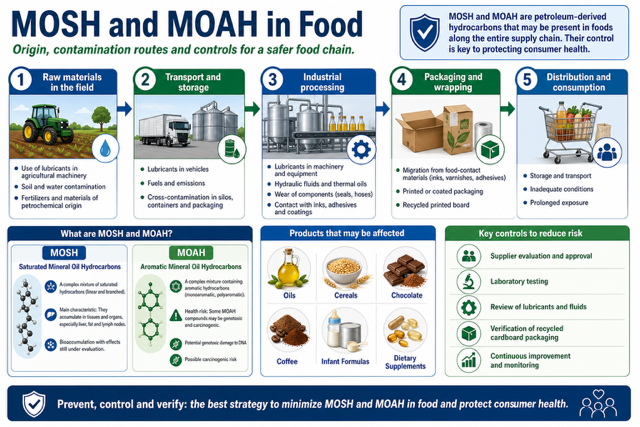
Mineral oil hydrocarbons, or MOH, are among the emerging contaminants most closely monitored in food safety. They are divided into MOSH, which are saturated hydrocarbons, and MOAH, which are aromatic hydrocarbons; this distinction matters because EFSA reports that MOSH can accumulate in tissues, while MOAH—particularly those with three or more aromatic rings—raise toxicological concern due to their potential genotoxic and carcinogenic properties.
This concern has increased focus on their occurrence and on how they enter the food chain. MOH can be introduced during harvest, transport, processing or packaging from sources such as machine lubricants, exhaust fumes, processing aids or migration from food-contact materials like recycled paper and board, printing inks and certain waxes.
Therefore, MOSH and MOAH do not affect just one product category but multiple food types, including oils, cereals, chocolate, coffee, infant formula and food supplements. Authorities and technical documents agree that contamination may originate in raw materials, industrial processing or final packaging, so risk assessment must be comprehensive and not limited to end-product testing.
Regulatory framework
Within this context, Commission Regulation (EU) 2023/915 remains the EU’s central reference for maximum levels of certain contaminants in food. Although that regulation is already in force as a framework, the European Commission is working on a specific amendment to introduce maximum levels for MOAH in foods, while MOSH will continue to be addressed via reference values used for control and investigation.
This regulatory shift is significant because the EU is moving toward maximum limits for MOAH, whereas MOSH is managed through indicative values. Reference values under consideration include 0.5 mg/kg for dry foods with low fat or oil content, 1 mg/kg for foods containing more than 4% and up to 50% fat or oil, and 2 mg/kg for fats, oils or foods with more than 50% fat or oil.
These values already serve in practice as action thresholds. When MOSH or MOAH are detected in a food, operators are expected to investigate the contamination source and implement corrective measures, integrating MOH control into preventive food safety management.
Additionally, the draft revision linked to Regulation (EU) 2023/915 indicates a planned application date of 1 January 2027 for the new MOAH limits. That date appears in sector documentation as the expected regulatory horizon, pending formal publication of the final amendment.
European market withdrawals
In recent years, MOSH and MOAH alerts have also been reflected in the EU’s RASFF system, the rapid alert network used by authorities to communicate risks and enable withdrawals or reinforced controls. Notifications have been recorded in several Member States, notably Germany, the Netherlands and Spain, confirming this is a shared market concern rather than isolated incidents.
How should we act?
Given this scenario, businesses should not limit themselves to end-product testing but implement a documented preventive strategy. This includes reviewing raw materials, suppliers, lubricants and processing aids, checking packaging suitability (especially when recycled board is used), and applying appropriate analytical methods to reliably detect and confirm MOSH and MOAH.
In practice, the regulatory shift pushes the food industry toward broader due diligence. Companies will need to demonstrate identification of critical contamination points, ongoing process monitoring and effective measures to prevent, investigate and correct any incidents before products reach consumers.
CONCLUSION
MOSH and MOAH currently represent one of the main emerging regulatory focuses in food safety within the European Union. Beyond analytical compliance, the regulatory trend is moving towards a comprehensive preventive management approach based on traceability, supplier control and the validation of materials and processes.
In this context, at Boavit Nutrition SL we anticipate future regulatory requirements, reinforcing our internal controls to minimize risks and working to respond quickly to possible incidents, guaranteeing at all times the safety and regulatory compliance of our products.

No Comments